+ By Vicki Meade + Photos by Jefferson Holland
The first rhyme that Jefferson Holland remembers creating, a tribute to his kindergarten teacher, goes like this:
“Mrs. Jones makes ice cream cones.” Ever since, he’s made good use of his gift for rhyme.
Named Poet Laureate for Annapolis for 2024–2026, Holland is a poet, singer, songwriter, storyteller, performer, and all-around wordsmith. “I always wanted to be a writer, from the time I was teeny tiny,” he says. Earning a journalism degree at the Pennsylvania State University was a big step toward his goal, but he didn’t want to report on crimes or disasters. “I wanted to write the fun stuff.”
And so he did, starting with verses to entertain his mother. “If I could make her laugh, it was good,” he says. He wrote scripts in college for a radio comedy show, penned tunes in the 1980s and 1990s as cofounder of the defunct folk group Crab Alley, and has written songs for the band Eastport Oyster Boys, which he launched with Kevin Brooks in 1992.
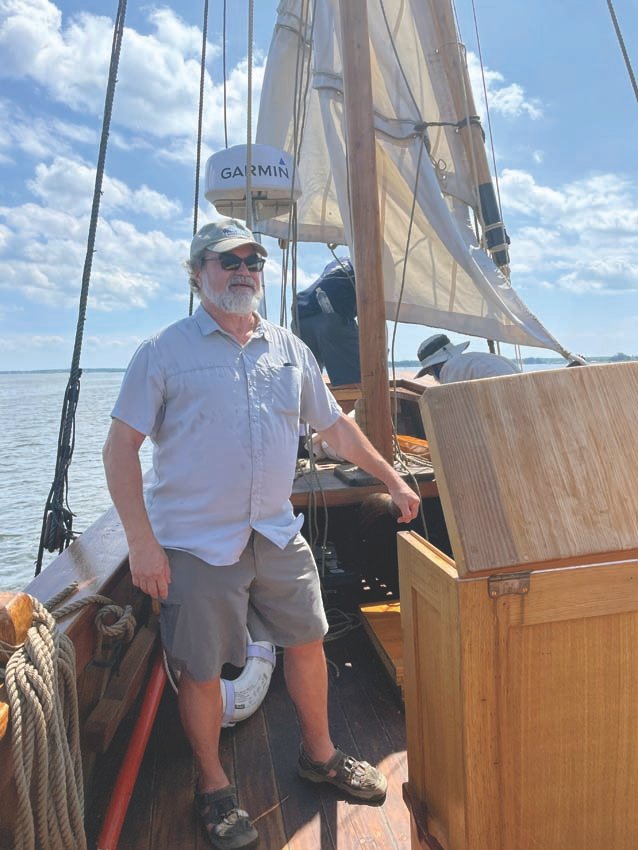
If Holland’s packed career were detailed in a résumé, it might be an inch thick. He’s been director of public relations for the Annapolis Boat Shows, the founding director of the Annapolis Maritime Museum, Annapolis’ assistant harbormaster, West and Rhode riverkeeper, head of the Captain Avery Museum, editor of Chesapeake Bay Magazine, biweekly columnist for The Capital Gazette, and chief of his own PR and event management company, Holland Lines, which promoted the 2001–2002 Volvo Ocean Race stopover in Annapolis. He’s even held make-believe jobs, such as minister of propaganda for the Maritime Republic of Eastport, the fictional nation formed when the Spa Creek Bridge closed for repairs in 1998 and the Eastport peninsula staged a mock rebellion to “secede” from Annapolis.
“Ode to the Equinox,” which commemorates the Burning of the Socks (an annual rite of spring founded in Eastport in the 1970s) is probably Holland’s best-known poem locally. It comprises 20 tightly rhymed lines and begins with, “Them Eastport boys got an odd tradition, When the sun swings to its equinoxical position, They build a little fire down along the docks, They doff their shoes and they burn their winter socks.”

Humor has always been important to Holland, and his writings often bend that way even when he seeks to be serious. “Once, I wanted to write a love song to my wife using a compass rose analogy and how I’d be lost without her,” he says. “I got going on it, then started making fun of myself, and it turned into a silly barbershop quartet about navigation.”
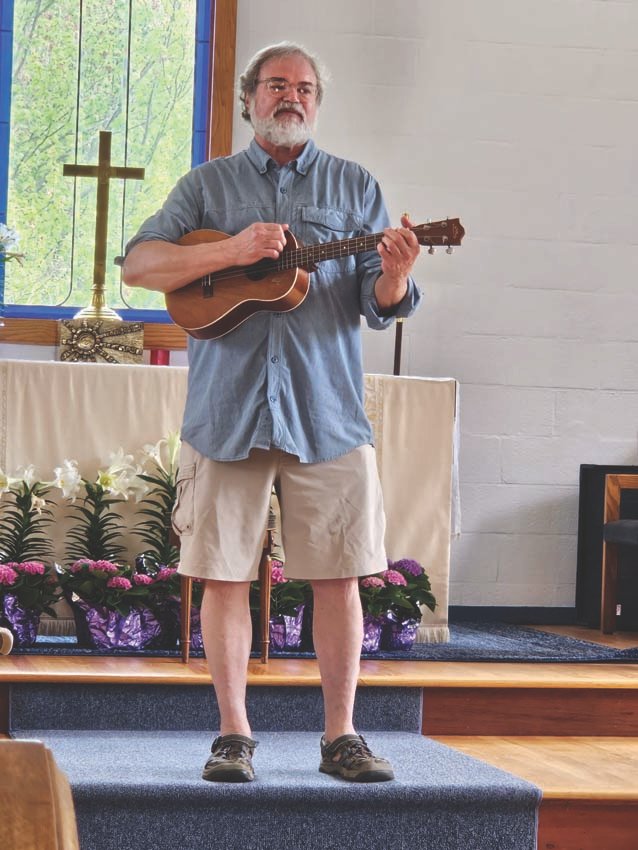
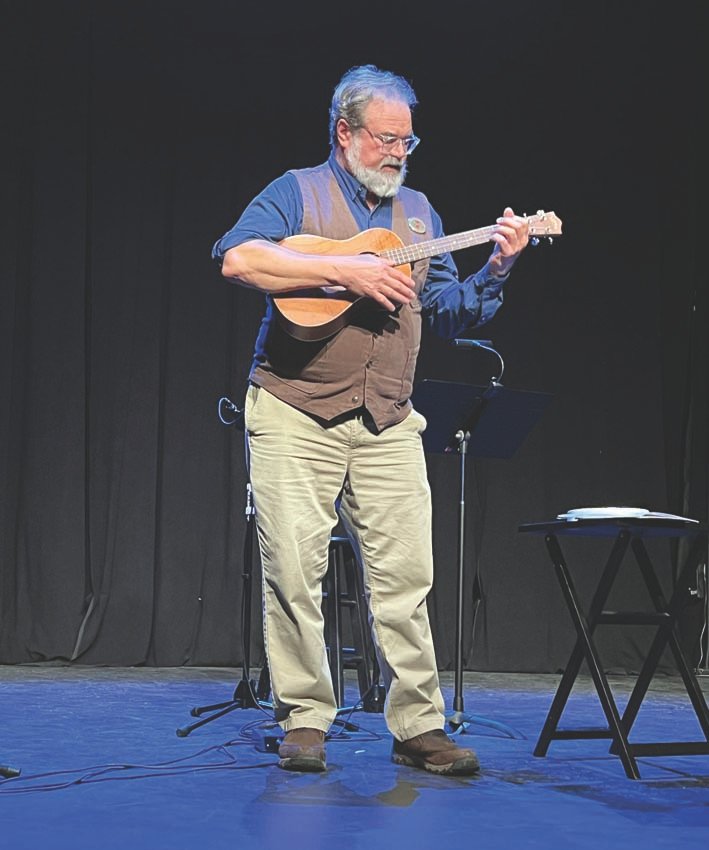
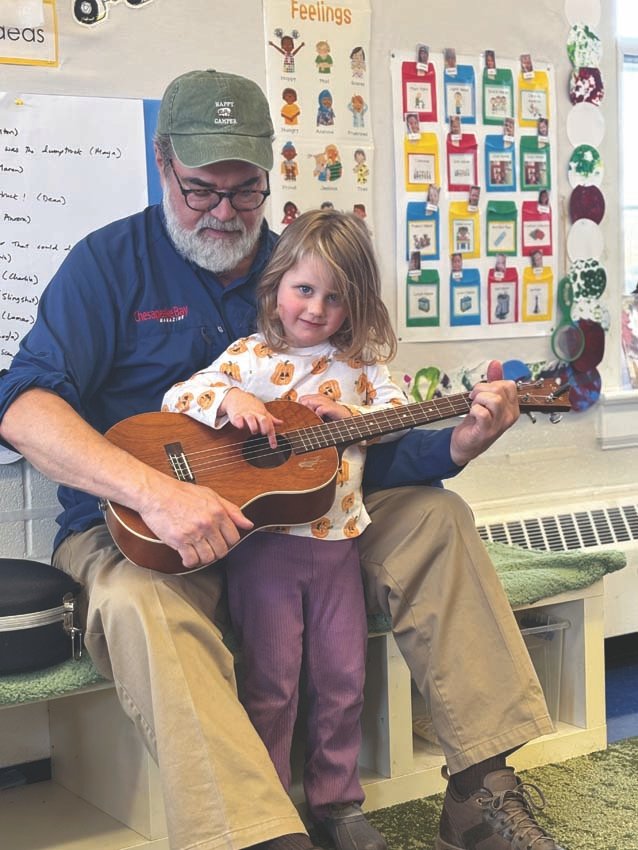
Holland’s early influences were Stan Freberg, host of a 1950s comedy radio show; Tom Lehrer, who composed and performed satirical songs; and William S. Gilbert and Arthur Sullivan, creators of comic operas in the late 1800s. Holland studied the flute in middle school but didn’t pursue it further. “I discovered I couldn’t sing and accompany myself on the flute,” he quips. He gravitated to the ukulele, which suited him better than playing guitar. “My uke has only four strings, and I have only four fingers,” he says.
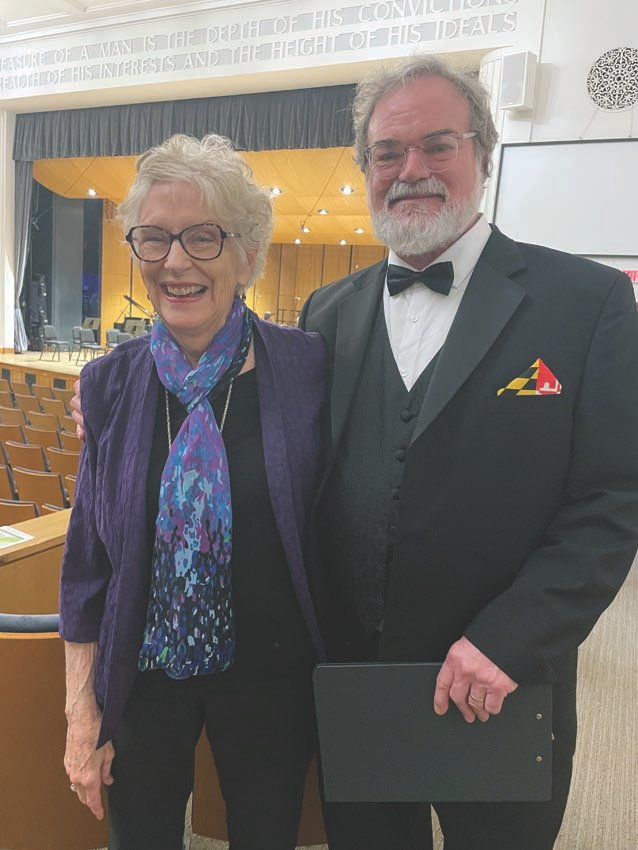
Whether writing lyrics or poems, the approach is the same, Holland says. Ideas often come to him when he’s driving but can arrive from anywhere, and he records them in his ever-present notebook. Inspirations also arise when he plunges into nature, such as while camping at primitive sites or hiking in the woods to reset his brain. Holland jots rough drafts while soaking in the bathtub and later types the revisions at his stand-up computer station. Then, with a careful eye, his wife, Louise White, a poet in her own right, makes edits and suggestions. “When I’m chewing on an idea, I have no idea how it will go,” he says, “and nine times out of ten, it will turn into something funny.” Things come to him when he’s drifting off to sleep at night. “Lines that don’t quite click repeat in my head,” he says, explaining how he might puzzle out a solution. “No poem or song is ever really finished.”
When he moved to Annapolis from Pittsburgh in 1981, Holland made it his personal mission to celebrate the Chesapeake Bay area’s heritage through tales and verse. “The Key to Annapolis History,” written in quatrains, explores the city’s founding, the harbor’s role in commerce, and how pleasure craft took over.
His country and western tune “Miss Lonesome,” about a waterman’s abandoned workboat, laments the decline of oysters in the Bay and the loss of a traditional livelihood. “It’s one of those rare situations where a song just came to me,” he says.

Telling a story through verse is what he most likes to do. He also enjoys reading poetry of all types and admires the epic sagas of Alfred, Lord Tennyson, and Lord Byron. “I recently rediscovered Byron,” he says, “and I hadn’t realized what a funny guy he was, making snarky comments about other poets of his time.” He loves reading Mark Twain’s works and will read them over and over.
As Annapolis’ Poet Laureate, Holland is tasked with promoting the literary arts and literacy in the community, and it’s up to him how he does that. He’s created an email list of local poets of all levels to whom he announces literary events and proposes poetry challenges, such as “Go to a historic site and write a poem inspired by people, places, ships, or events.” “I want newcomers to see what fun it is to write and share your stuff,” he says. His poem “For the Young Poets of Annapolis” contains this instructive stanza:
First, your brain flashes with hot inspiration,
When asked what triggers his creative bursts, Holland responds in his calm, assured voice, “Rage.” Not what one expects from a man who delights in humor. But he goes on to explain. “When things aren’t fair, I get angry,” he says. “And that often inspires me to write something silly.” He says that his work is also kindled by “something that is just crying out for treatment—like the sock burning.”
Although Holland left the Eastport Oyster Boys in 2011, he makes cameo appearances with Brooks and other band members Tom Guay, Mike Lange, and Andy Fegley. “I love to perform—I’m a ham from way back,” he says. But these days, he prefers performing solo.“It’s a lot easier for one person to do a gig than to try to get five guys together.”
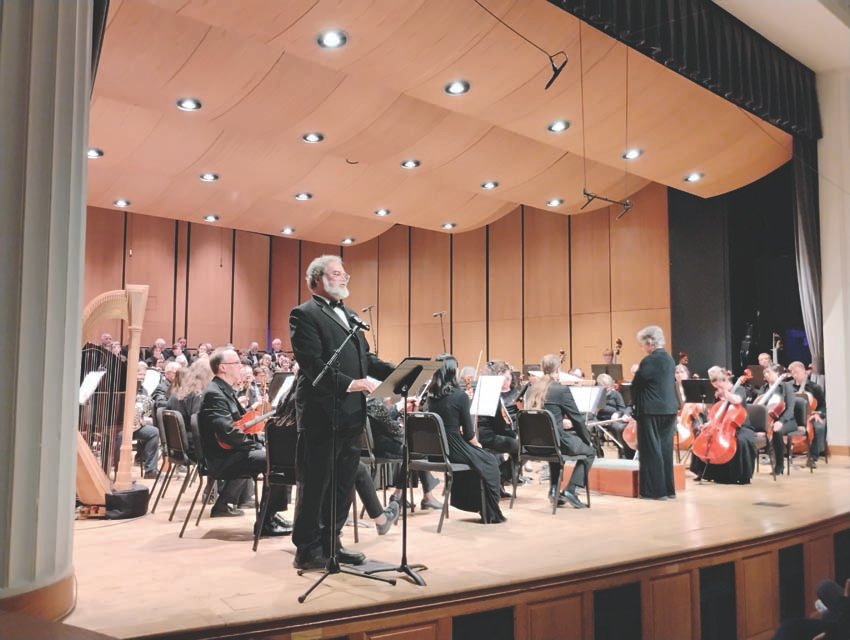
Currently, Holland is compiling newspaper columns that he authored on Maryland natural history for publication as a book, drafting a protest song, and sketching two as-yet-unformed poems. He already has some books under his belt, including Chessie: The Sea Monster That Ate Annapolis, an illustrated tale for children, and a collection of columns, Walk Around Arundel: 52 Places to Hike with Your Dog (and Other Best Friends), published by New Bay Books in 2024.
“What I’m doing now is exactly what I always wanted to do,” says Holland—celebrating Annapolis, encouraging other writers, performing songs and stories, and playing with words. “I’m the happiest guy in the world.”